Please note this article contains spoilers for This Bright Life.
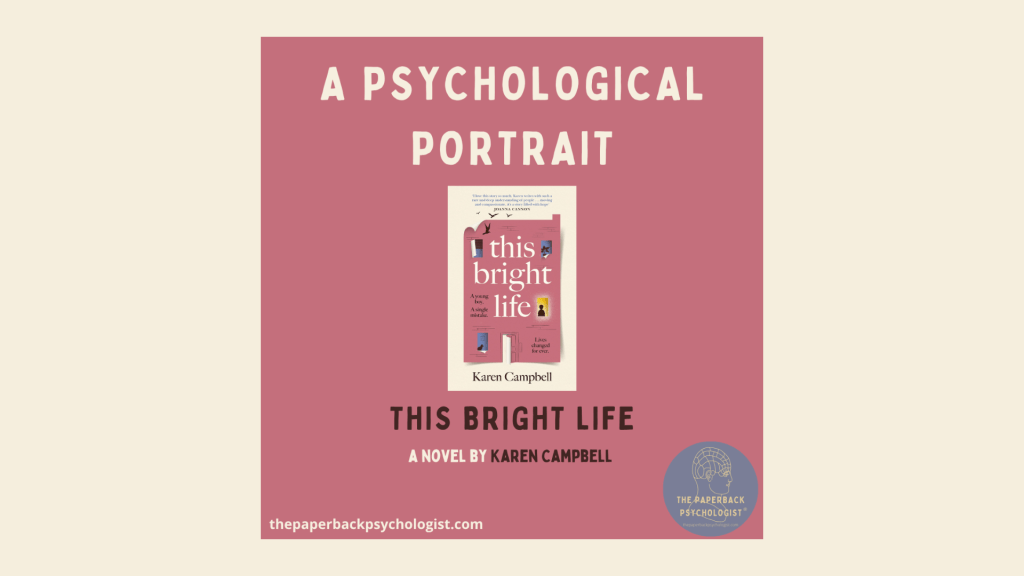
This Bright Life is the latest novel from Scottish author Karen Campbell. The Saltire Awards 2025 shortlisted novel was published in 2025 by Canongate Books (with the paperback out now). This is my second Karen Campbell book, with the excellent Paper Cup being the focus of a psychological portrait a few years ago (Paper Cup, Karen Campbell – A Psychological Formulation #10 – The Paperback Psychologist). In my opinion, This Bright Life surpasses Paper Cup. Across it’s pages we follow the lives of Gerard, Margaret and Claire, three characters from different backgrounds and at very different stages in life. All of their lives are changed one afternoon as Gerard, aged 12 years old, desperate for food and nappies for his baby sister, attempts to steal Margaret’s purse. Claire, a bystander then steps in to help Margaret. Throughout the course of the novel, we gain an insight into each of their lives, with each character drawing us in. We are thrust into their plights and Campbell’s writing elicits strong feelings of genuine care and concern for each character.

This Bright Life, whilst dealing with themes of substance use, trauma and grief, has immense heart, hope and contemplates the possibility of change. All three characters face challenges and hardship, with each finding resolution through the course of the novel. The ending of the book felt genuine and earned, with glimpses of hope for Gerard, Margaret and Claire. These were fitting conclusions, whilst not being overdone. The final sections were highly emotional, and these three characters will stay with me for a long time.
Each of the three main characters could be explored with a psychological portrait, however for the purpose of this blog post, I will focus on Gerard. I felt most drawn to his story and the many facets of his character created a deep emotional connection. Gerard’s story unfolds throughout the course of the novel, with the shocking truth of his early traumatic experiences revealed. This traumatic event, as well as sending him into the care system for the first time, had a profound psychological impact on him. Gerard experienced care from others as inconsistent, with his mother struggling with her substance use, meaning that she was regularly physically and mentally absent from Gerard and his two siblings. Gerard at just 12 years old, had to assume the parental role to his younger brother and baby sister. It is these very circumstances that lead to his fateful meeting with Margaret, as he struggles to find a way to feed and care for his siblings. Gerard’s other experience of care from people is from professionals and foster carers. Whilst this is more consistent, Gerard can experience this as transactional, controlling, conditional and changeable. Gerard is likely therefore to find forming relationships with others difficult and it hard to trust others. Furthermore, this appears to impact on how he sees himself, viewing himself as “bad” and “scum”. Gerard is dealing with ongoing trauma symptoms, including flashbacks and dissociation, because of witnessing the murder of his father when he was just 4 years old. In the psychological formulation below, I consider the likely coping strategies and protective behaviours that Gerard uses to protect against past and current threat. We can see how these lead directly into the key events of the novel and effect the course of his life.
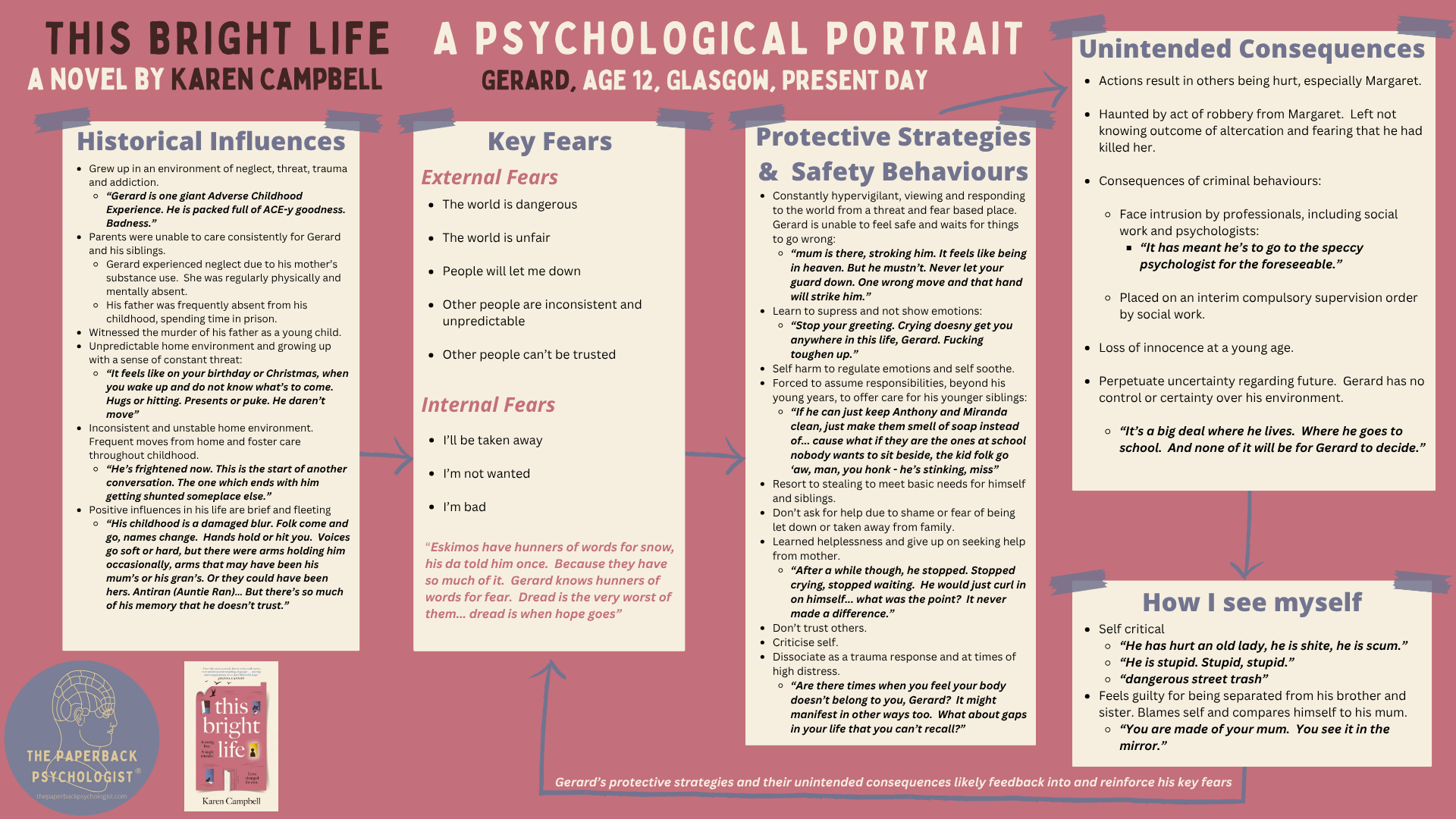
As well as explore the threats and challenges that Gerard faces, I thought it also important to highlight the more positive aspects and strengths of his character. Indeed, I consider the novel to be a story of hope, so to not include this would do an injustice to Gerard. We see some positive and stable adult influences in his life with his aunt, foster parents and some professionals. His aunt comes into the end of the novel bursting with compassion and strength, a real hero that steps up for Gerard and his siblings.
The juxtaposition of the Gerard we get to know from his sections of the novel, compared to Margaret’s perspective is stark. Margaret views Gerard as an assailant who has caused considerable physical and psychological damage to herself. These shifting perspectives across narrators creates an important dialogue for the reader, to consider the complexities and challenge their own views on the most vulnerable in society. This culminates beautifully in the closing scene in the novel, when Margaret and Gerard are reunited. At the graveside, she sees him for the young vulnerable boy that he is rather than the view of him as a monster or thug that he Margaret had held on to for so long.
Gerard would unlikely not appreciate me writing this. He’s had enough of professionals commenting on and deciding the course of his life.
“It has meant he’s to go to the speccy psychologist for the foreseeable.”
I would hope though, that if the “speccy psychologist” were to work with Gerard and develop this formulation together as part of psychological therapy, this could be a helpful tool for him to make sense of his life and the events that have shaped him in a compassionate and validating way.
Compassion Focused Therapy formulation adapted from material developed by Professor Paul Gilbert, Clinical Psychologist for http://www.compassionatemind.co.uk
Thank you to Canongate and Netgalley for the proof copy.
Read more psychological portraits of fiction at thepaperbackpsychologist.com
Follow @thepaperbackpsychologist on Instagram
To support my work and to allow me to continue applying a psychological perspective to literature, please consider making a donation here.


Leave a Reply