
Please note this article contains spoiler for Juno Loves Legs.
Juno Loves Legs is a beautiful and devastating novel with so much heart. It tells the tale of Juno, an incredibly resilient and strong young girl growing up in 1980’s Dublin. It’s a love story of friendship between Juno and Legs. Two outsiders, who fight to survive in a world defined by control, abuse and neglect, which is thrust upon them by their parents, the church and their community.
Karl Geary deftly and compassionately explores themes of alcohol misuse, homelessness, sexuality, sex work, and the oppression and abuse from those in power. With Juno and Legs, Geary has created two timeless characters that you care deeply for and are wholeheartedly invested in. The reader is compelled to root for them, to not just survive the many adversities they face, but hope for them to thrive and truly find happiness. It is this emotional investment that makes the story so heart-breaking when we realise that the odds are overwhelmingly stacked against them and these hopes are sadly out of reach.
As a reader, we understand Juno and Legs’ plight and with this understanding comes a compassion that we can bring to make sense of their actions when they act in ways that are harmful to others: for example, when Juno steals from Agnes; attacks her father; or when a young Legs attacks the priest at school.
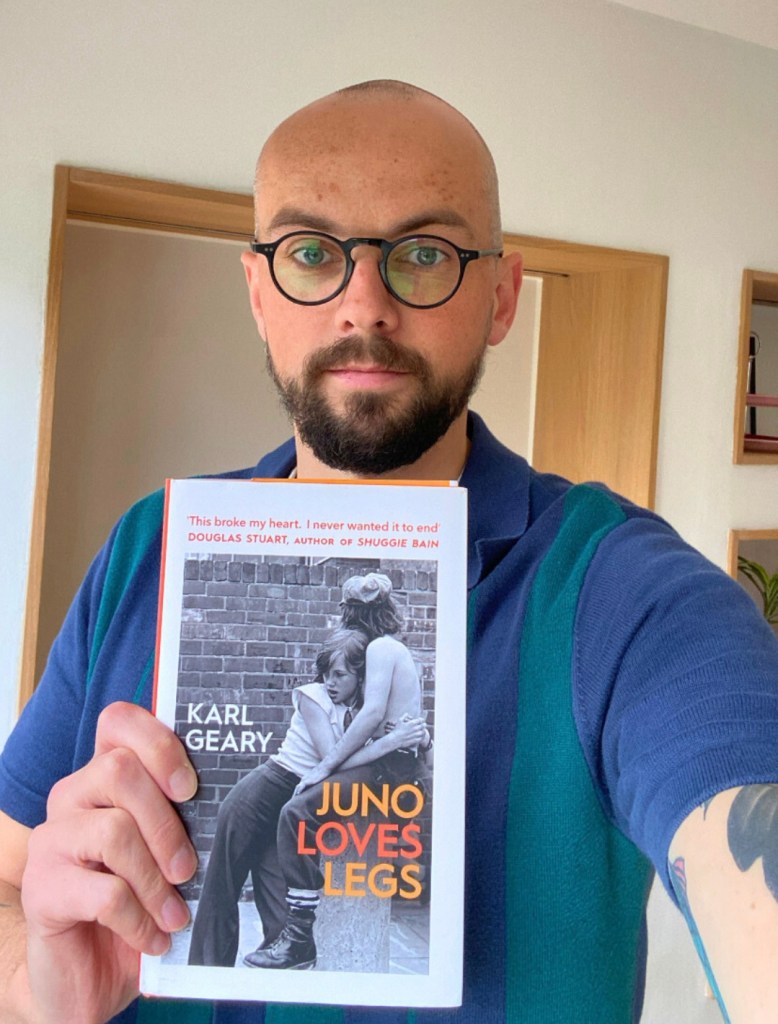
Juno: A Psychological Portrait
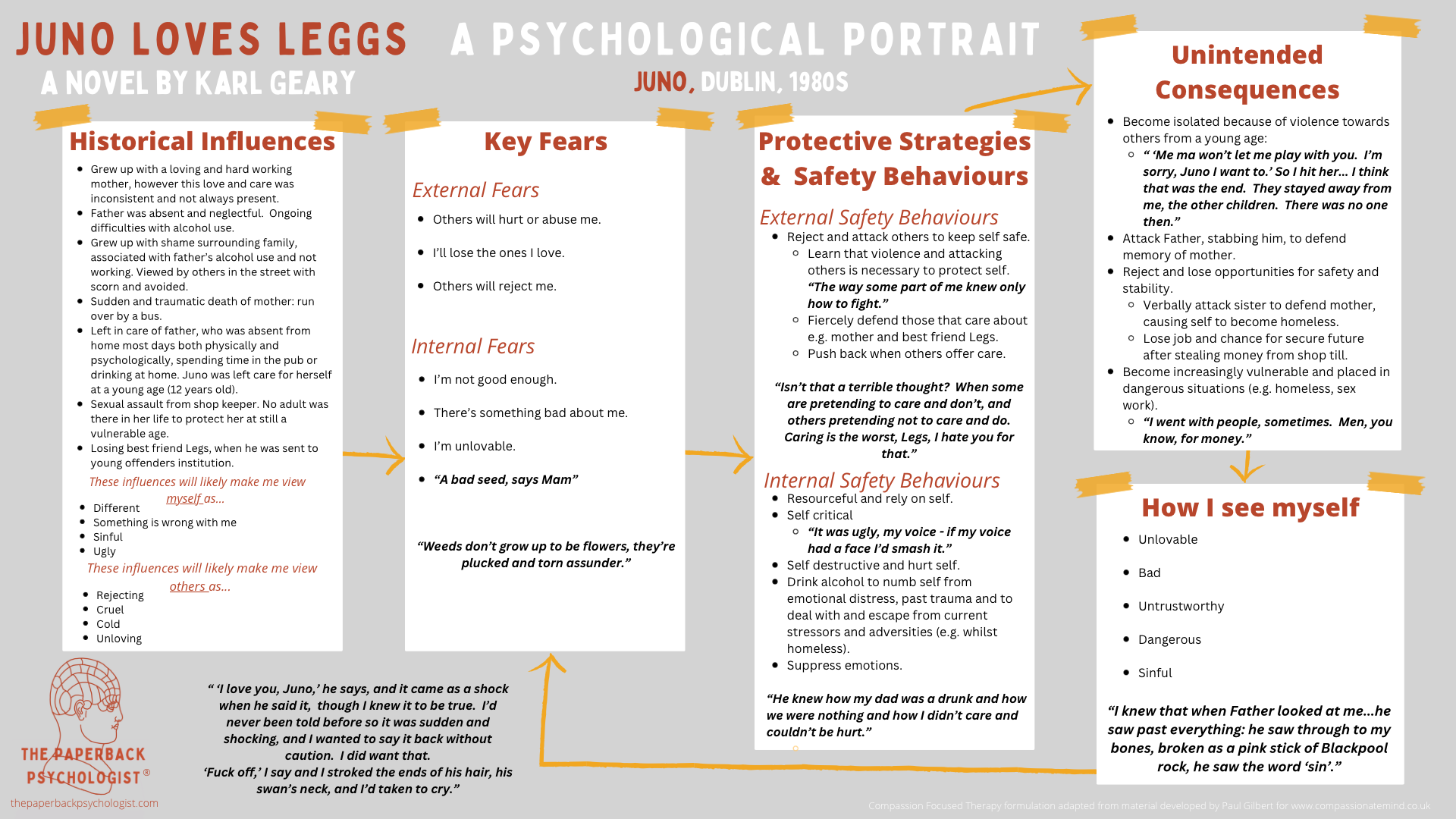
I was gripped by Juno’s journey and Geary’s characterisation of Juno peaked my Clinical Psychologist’s brain. After reading the novel I quickly set to work writing out a psychological formulation for her. As with all of my writing, this is my own interpretation of Juno and the work of Karl Geary.
Care is a central theme of Juno’s psychological portrait and is explored in the diagrammatic formulation below. Her complicated relationship with care, is a thread that runs the entirety of the novel. As a chid, care was inconsistent from her mother and entirely absent from her father. The tragic and sudden death of Juno’s mother, results in her being left with a father who was both emotionally and physically neglectful. These are experiences that are likely to foster key fears in Juno, which are deep seated fears she may have about herself and the world. Experiences of care like Juno has endured, coupled with trauma (the sudden and violent death of her mother, and sexual assault by shop keeper) may elicit key fears such as: I’m unlovable, not good enough, I’m bad, others will hurt or abuse me and others will leave.
To protect against these fears, Juno will have developed coping strategies and safety behaviours. These appear to be primarily focused on keeping herself isolated from others who may cause harm or let her down. To do this Juno needs to be resourceful to survive on her own but she is also attacking and rejecting of others. This develops a fierce tenacity and capability in Juno but keeps others at a distance. While it may offer Juno some safety from possible harm, this becomes her default way of interacting with the world. This results in Juno becoming increasingly isolated and she misses out on some important opportunities to receive help and care from others. The unfortunate consequences of this, is the escalation of her safety behaviours, to the point where she violently severs ties with her father and sister and then becomes homeless. As a reader it is heart-breaking to see how Juno’s actions, which are meant to protect her, cause her further harm and result in her key fears becoming a reality. This creates a vicious cycle and further entrenches her safety behaviours.
Juno and Legs beautiful relationship and their reunion allows both Juno and Legs to receive the care and love that they did not receive from their own families. Through her friendship with Legs, Juno is given the opportunity to challenge her key fears, relax her safety behaviours and allow her self to both give and receive care. It appears that this may be transformative for Juno, as at the end of the novel we witness Juno tentatively allowing care in from the librarian, Missus H, through the invitation into her home for safety and a cup of tea. We can only hope that this grows into Juno allowing others safely into her life, finding safety, consistency and care, and to break free from the hold that her devastating early experiences have had on her life.


Leave a comment