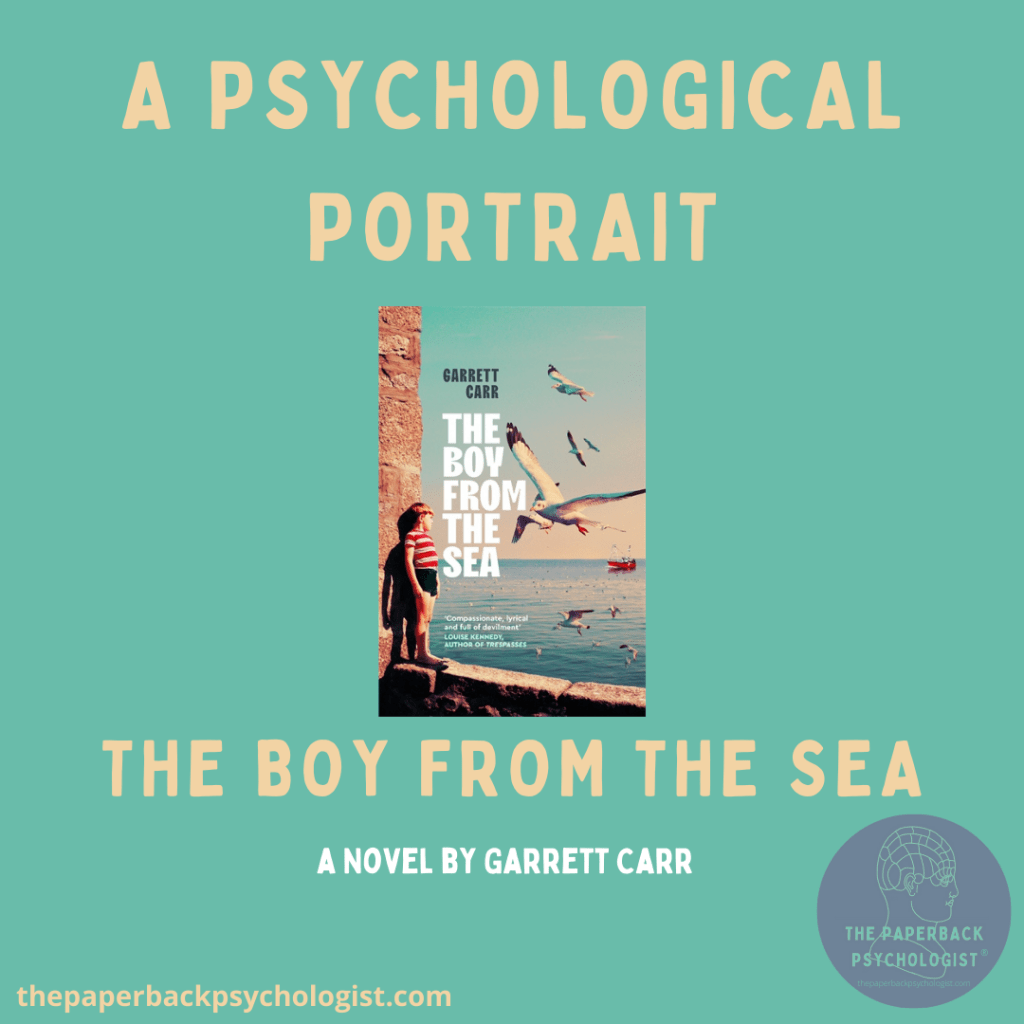
Garrett Carr’s debut adult novel, The Boy from The Sea landed on the literary shore, much like the book’s protagonist, Brendan Bonnar: unexpected, mysterious, packed full of heart and special. The book is a marvel, an intimate tale of a family and small rural community in a fishing village in the west coast of Ireland. The Boy From The Sea released in February and has quickly received much acclaim, reaching The Irish Times No.4 Bestseller, a Sunday Times Best Book of 2025 and an Observer Best Debut of 2025.
(Please note this psychological portrait contains spoilers for the book)

Brendan Bonnar is at the heart of the novel, and we follow him from a baby found on the shore, to an 18 year old adult. I found the relationships within the novel to be the most interesting, with Brendan, the Boy From The Sea at the centre of it all. Garrett Carr has written a fascinating exploration of Brendan’s relationships with those around him: his brother, parents, aunt, grandfather and wider community, but also Brendan’s relationship with himself. We can see that within these relationships, that here is an oscillation between holding Brendan up as special, a miracle and someone to be revered; or they put him down, shun, fear and view him with disdain and push him away. It appears for Brendan that he struggles to find that middle ground, to just be a son or a brother. The novel charts his journey into adulthood as he navigates these opposing constructs. This uniqueness and struggle to belong is apparent to his adoptive mother Christine, since he was found as a baby on the shore:
“She leaned close and looked at his face, it was strange to do so without the usual impulse to find connection, seeking traces of herself or her husband. There was none of that and it made this baby seem a complete individual, unique and a boy who’d need help to achieve belonging.”
Using a Relational Approach for a Psychological Portrait
When choosing a psychological approach for the novel, I was drawn to a Cognitive Analytic Therapy (CAT) based approach. CAT is a form of psychological therapy that I often use when there are strong relational themes and difficulties and so this felt fitting for The Boy From The Sea. From a CAT perspective, children are hypothesised to learn from what they experience from the world and people around them. It is thought that children internalise the patterns that play out in these early relationships, particularly from care givers and those closest to them. These are called reciprocal roles which are proposed to be re-enacted in future relationships, both with the self and others. So basically, we learn ways of relating to other people and also ourselves from a very young age, and these relationship themes colour our interactions throughout our lives. In this form of psychological therapy, we typically identify a small number of relationship themes (reciprocal roles) and consider how these connect to our emotions, behaviours and difficulties we might face. This is all mapped out on paper in a formulation called a “CAT map.”
Brendan Bonnar, A Psychological Portrait
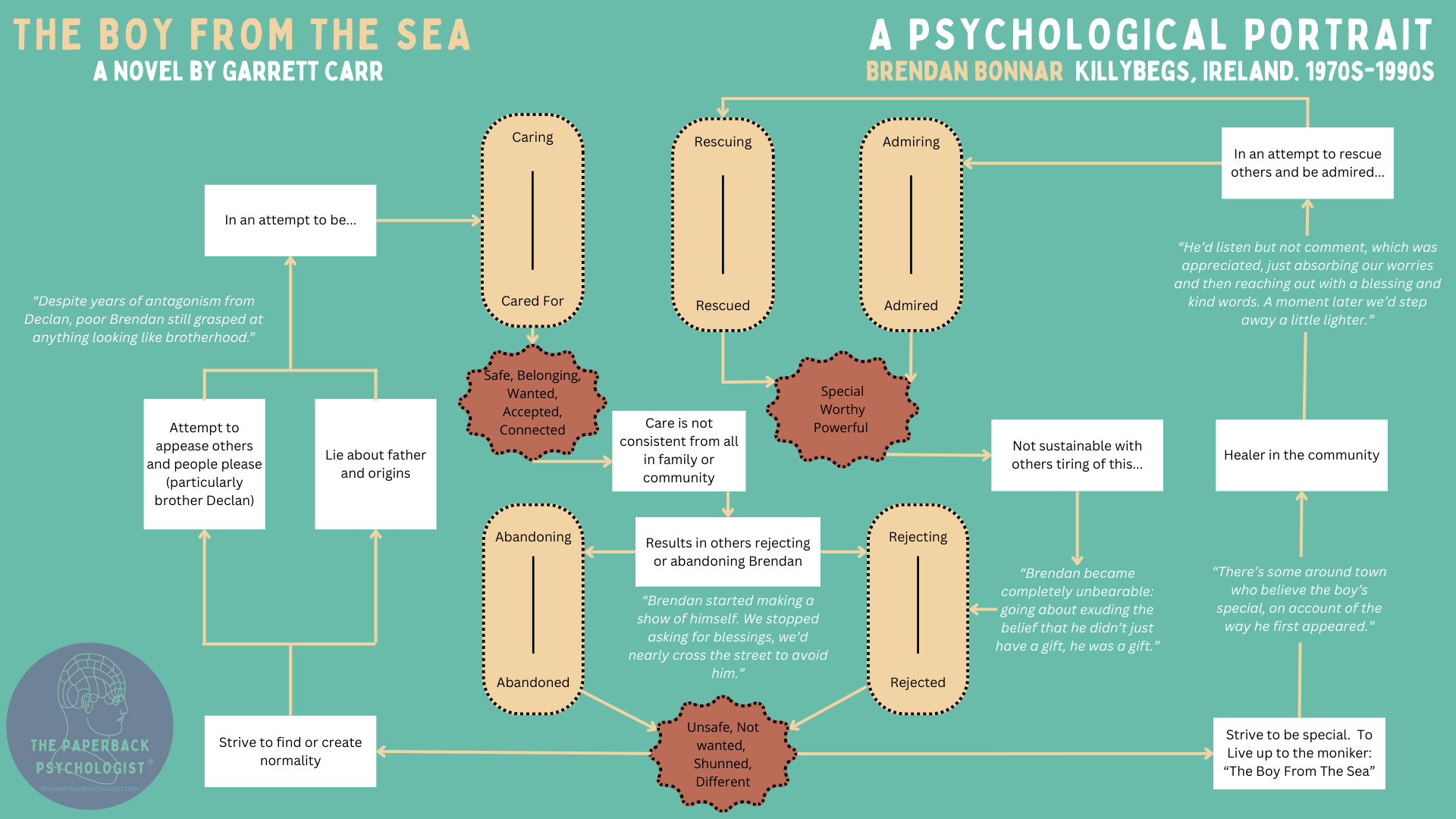
For the character of Brendan Bonnar, I consider that there are five key themes that influence his relationships and his journey throughout the novel: being cared for, rescued, admired, abandoned and rejected. Furthermore, two important contrasting patterns of behaviours seem to be prominent for Brendan: to strive to be special; and to strive to find or create normality. Below is my version of a CAT map which provides a diaphragmatic representation of the formulation for Brendan. This should be read in conjunction with the proceeding text to better understand this psychological portrait of Brendan Bonnar.
Brendan Bonnar, A Psychological Portrait
From birth, Brendan appears to experience a diverse mix of relationship roles, that form and shape his character throughout his life. As a baby, he experienced rejection and abandonment as his birth parents sent him off into the sea. He was however quickly rescued by the community and the Bonnars offered the safety and care that his birth parents were unable to provide. We can conjecture then, that Brendan’s character feels the push and pull of these four different relationship roles of Caring, Rescuing, Abandoning and Rejecting. Moreover, with the sudden and miraculous nature of his arrival, the community view him as special and revere and Admire Brendan, The Boy From The Sea.
With these relationship roles in mind, we can chart Brendan’s journey and relationships with others and himself through the prism of these relational themes. Brendan is motivated to seek that perfect care and acceptance that he did not get from his birth parents. This care however, is difficult to achieve and somewhat limited, when his adoptive brother, aunt and grandfather all appear to reject him. This was most apparent in his adoptive brother Declan’s relationship with him, which seems to be driven by competition, dismissal and rejection:
“He wouldn’t, couldn’t let go of the idea that Brendan was an interloper in his family.”
We then see Brendan lean into his moniker of the special Boy From The Sea through offering spiritual healing to the community which emboldens his perceived specialness and makes the community admire him further. By engaging in these acts of healing, Brendan may be re-enacting the rescuing relationship role, just as he was rescued as a baby, he is now rescuing others. Rescuing others and being admired are likely to make Brendan feel good and accepted by the community, which will only reinforce and encourage these behaviours. This cannot be sustained however, and after some time, the community appear to tire of his specialness and the admiring turns to rejecting and abandoning. Being in this place is likely to make Brendan feel a host of negative emotions and to feel unsafe. This is somewhere that Brendan would not like to be and will try and find ways to get back to feeling cared for, rescued or admired.
We see Brendan most at peace when he seeks normality, connection and care from the Bonnars. Throughout the novel, we witness some attempts at achieving this both successfully and unsuccessfully. This is most prominently shown when he creates lies and rumours that he is the illegitimate son of Ambrose Bonnar. In doing so he is casting off the mystery and miraculous nature of his origins, in favour of a genuine and biological connection to his adoptive father. Unfortunately for Brendan, when it is revealed that he is the source of these rumours and these are false, this pushes his adoptive mother and brother to a place where they reject him. This attempt at connection and normality backfires and leaves him feeling unsafe and further disconnected from his family.
The accompanying diagram which shows these relationship roles for Brendan can also be a way for the reader to consider their own feelings towards the character and how as a reader, we too may be pulled into a different way of relating to Brendan throughout the course of his life. At times in the novel, I noticed myself being drawn to a place of admiring Brendan, of believing in his uniqueness and potential spiritual powers. However, I also noticed that this did not last, and like the community of Killybegs, I too found myself tiring of him and being drawn more to a place of wanting to reject or abandon him. Feeling this push and pull and fluctuating relationship with a fictional character, demonstrates the power and mastery of Garrett Carr’s writing and made The Boy From The Sea such a wonderful and engaging book. I think that part of the success of pulling the reader in was achieved by the use of the community as narrator for the novel. This grounds the reader within the community of Killybegs, creating an intimacy and connection, as we join the community in trying to understand the story of Brendan, the Boy From the Sea.
The ending of the novel was striking in its reveal around Brendan’s origins. Declan and his aunt seek out Brendan’s birth parents and it is revealed that Brendan is not from a miraculous beginning but instead rather tragic circumstances. We are given sparse information but enough to suggest that Brendan’s mother was very young and vulnerable when she became pregnant to an older man. The way we process this new information, is through Declan’s reaction and actions following this reveal. Declan appears to shift in his attitude towards Brendan, from a place of rejection to one of compassion. For Declan, his brother was no longer someone special, that he was in competition with but a vulnerable child that was in need of care. It is through Declan’s softening towards Brendan and the development of a brotherly relationship, that begins to create the normalcy and connection of family that Brendan was craving. This appears to allow Brendan to halt his pursuit of being admired as the Boy From The Sea and just be Brendan Bonnar, the son of Ambrose and Christine and brother of Declan.
The Boy From The Sea is out now. Thank you to Picador and Netgalley for the advanced reading copy.
 The Paperback Psychologist
Leave a comment