Please note: This article contains spoilers for Caledonian Road.
Caledonian Road is the latest novel from Booker Prize nominated author Andrew O’Hagan. It is a book of epic proportions, with a host of principal characters who are all part of a complex and interconnected web. Campbell Flynn is at the centre of the novel and over the course of one year we witness his life and society unfurl.
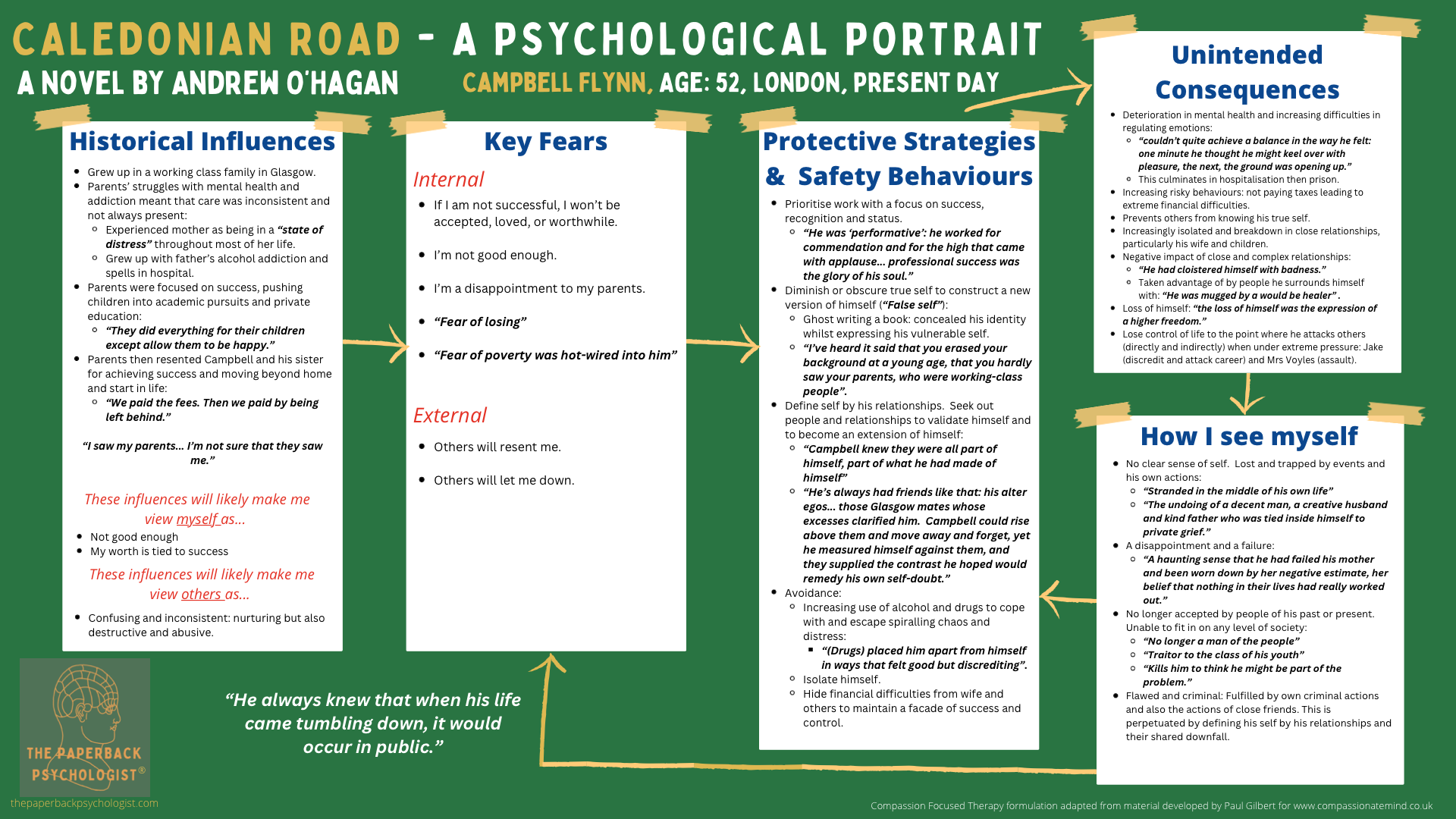
What follows, is a psychological portrait of Campbell Flynn. I have written this psychological portrait, playing with the pretense of meeting him at the end of the novel. Meeting a Clinical Psychologist is something that may well have happened for Campbell, either during his time in a psychiatric hospital or in prison. During this meeting, time would be taken to get to know him and make an assessment of his current difficulties, with this culminating in a psychological formulation. This is a piecing together of the events that have likely shaped him as a person, with an attempt to understand and contextualise the difficulties that he currently faces. I have written this formulation based on the information in the novel but present this in a way that would normally be done collaboratively with the individual accessing therapy.

Andrew O’Hagan’s writing creates wonderfully real characters that are equally brilliant and flawed as individuals. It is these nuances to character that make the book so compelling and Campbell so fertile a character for a psychological exploration. There is a wealth of information about Campbell: from his early working class beginnings in Scotland; to him scaling the heights of London society as a Professor and marrying into the the British aristocracy.
Some key themes emerge from Campbell’s life and spectacular downfall. O’Hagan explores the nature of the self through Campbell and his web of friends and acquaintances. Campbell’s sense of self appears fragile and uncertain. It is likely shaped by his nascent experiences, growing up with parents who provided care that was inconsistent and a home where success was valued more than happiness. Campbell appears to attempt to protect his brittle self through forming close relationships. These relationships appear to not only just influence Campbell’s self but that these individuals become part of Campbell’s character and help him construct a new self supplemented by those around him. This presents a number of risks for Campbell, as others may seek to take advantage of him, which is seen in his relationship with Milo. Furthermore, as Campbell’s sense of self is defined by others, it is vulnerable to being damaged when Campbell’s friends face controversy and failure. Campbell’s search for self and attempts to protect and artificially construct it, are unsustainable and appear to leave him trapped in a cycle of having no clear sense of self and seeing himself as a failure.
“her father might occasionally be haunted by a ‘false self’.
‘What’s that?’ Kenzie had asked.
‘A person you’re not, but who feels essential. In other words, a made-up self that a person can use as a shield to protect their true self… A child needs reassurance, and if she doesn’t get it then a false self can take over. She grows up feeling there can be no real openness, because the true self isn’t good enough.’
‘And that’s Daddy?’
‘Possibly.’“
Other themes are explored by O’Hagan, including: the role of money in Campbell’s life and how shame forces him to hide his financial problems; the oscillation between trying to heal himself and self destruction; and avoidance, which is primarily enacted through substance and alcohol use. All of these themes are explored below in a psychological portrait of Campbell Flynn:

 The Paperback Psychologist
Leave a comment