
*Please note, this post contains spoilers for the book*
When I read Graeme Armstrong’s The Young Team earlier this year it resonated with me on a number of levels. Growing up in Hamilton, South Lanarkshire and being a teenager in the 2000’s, there was so much in this book that seemed familiar. From the music, visits to Strathclyde Park, the language and slaggings (I hadn’t heard “yer maw” for years!), and even quotes from my local paper The Hamiliton Advertiser, it all felt very close to home.
Whilst I might never have owned a Berghaus and a bottle of Bucky wasn’t my drink of choice, the young teams of Hamilton were very prominent in my teenage life. They were our class mates at school and the graffiti around the town clearly identified and warned of the different teams of postcode warriors. What struck me from reading this, was how well Graeme Armstrong handled his characters, telling of the violence, alcohol and substance use that we might all assume would be part of the gang members’ lives. But more than just showing the chaos and brutality that surrounds these young men, we see the comradery and important role that these gangs played in shaping their lives and giving them a place to belong, from the young teenagers to elders of the group.
I was most gripped and moved by Armstrong’s sensitive and compassionate handling of trauma, anxiety and substance use. I believe that this is key in bringing his characters to life as we get a true insight to their lives and the incredibly challenging and adverse environments they inhabit. Moreover, this challenges the stereotypes or fears we may have held of the Scottish “ned”, something I must admit I was guilty of holding as a teenager.
The Young Team is a truly compassionate handling of these young mens’ stories which is likely to shatter the beliefs and negative stereotypes that many may have held of these groups. I think the Young Team is a seminal Scottish novel and should be read by all in in Scotland and beyond.
A Psychological Formulation of Azzy Williams
I have chosen a Compassion Focused Therapy (CFT) based approach for my formulation of Azzy Williams, the protagonist of the novel. I have used this to explore his early experiences and the environemnt that he has grown up in. The formulation in the diagram below, considers the impact that this may have had on how he sees himself and others and is likely to develop into key fears about himself and the world. In an effort to protect himself from these fears, I have considered the likely defensive or safety behaviours that Azzy has adopted. As we can expect, these can lead to further difficulties (unintended consequences). We then consider how this is likely to impact on how Azzy sees himself (self-to-self relating). As can be seen in the formulation below, this leads to a vicious cycle of safety behaviours that many struggle to break out of.
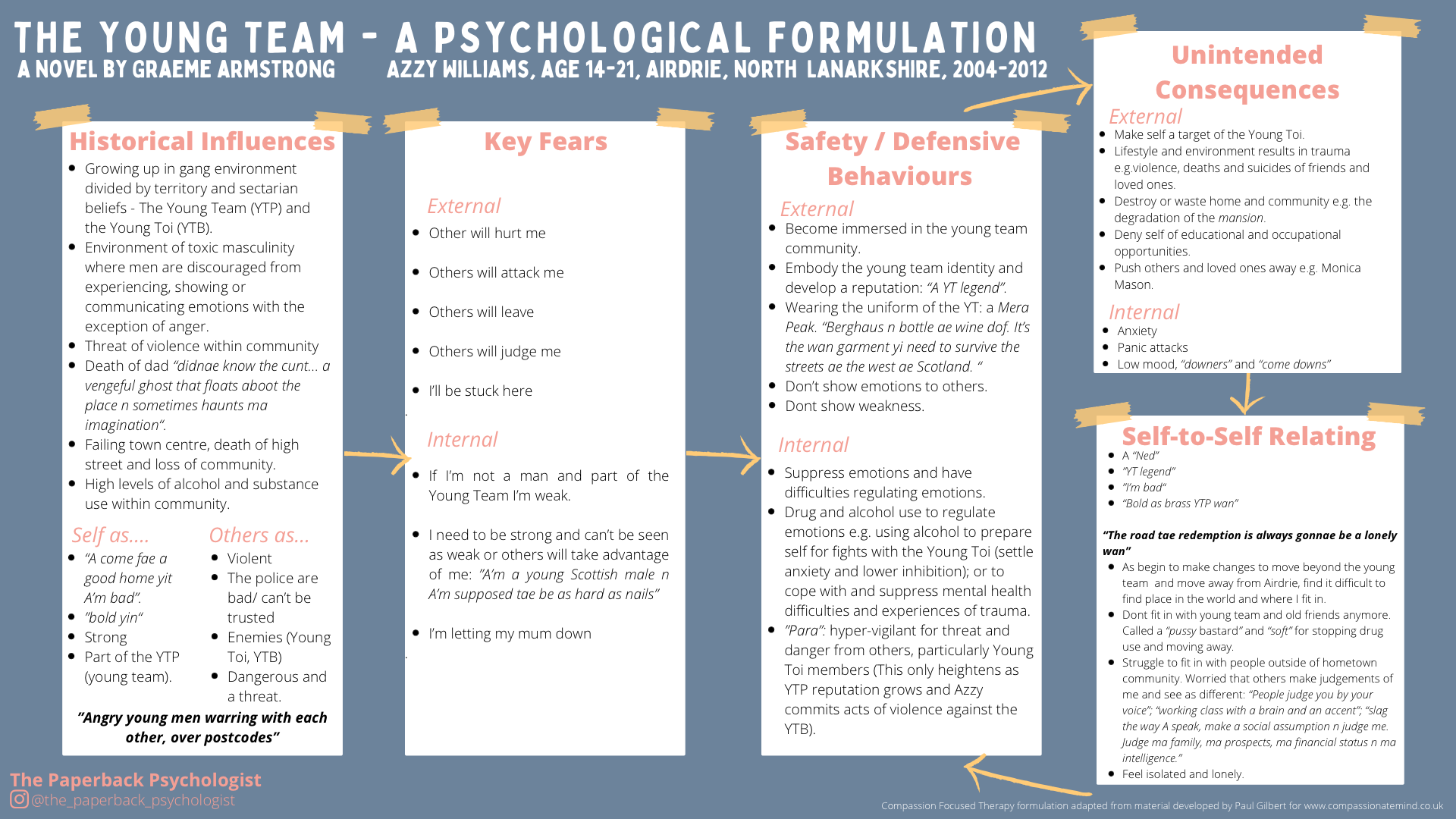
As Azzy’s journey develops and he begins to move away from the Young Team and his home town (“The road to redemption”), we see him make a number of chances to his life. In the formulation, I also consider the difficulty that he faces after making these changes, in fitting in with his old friends and from forming new friendships in other social groups.
Anxiety and Panic
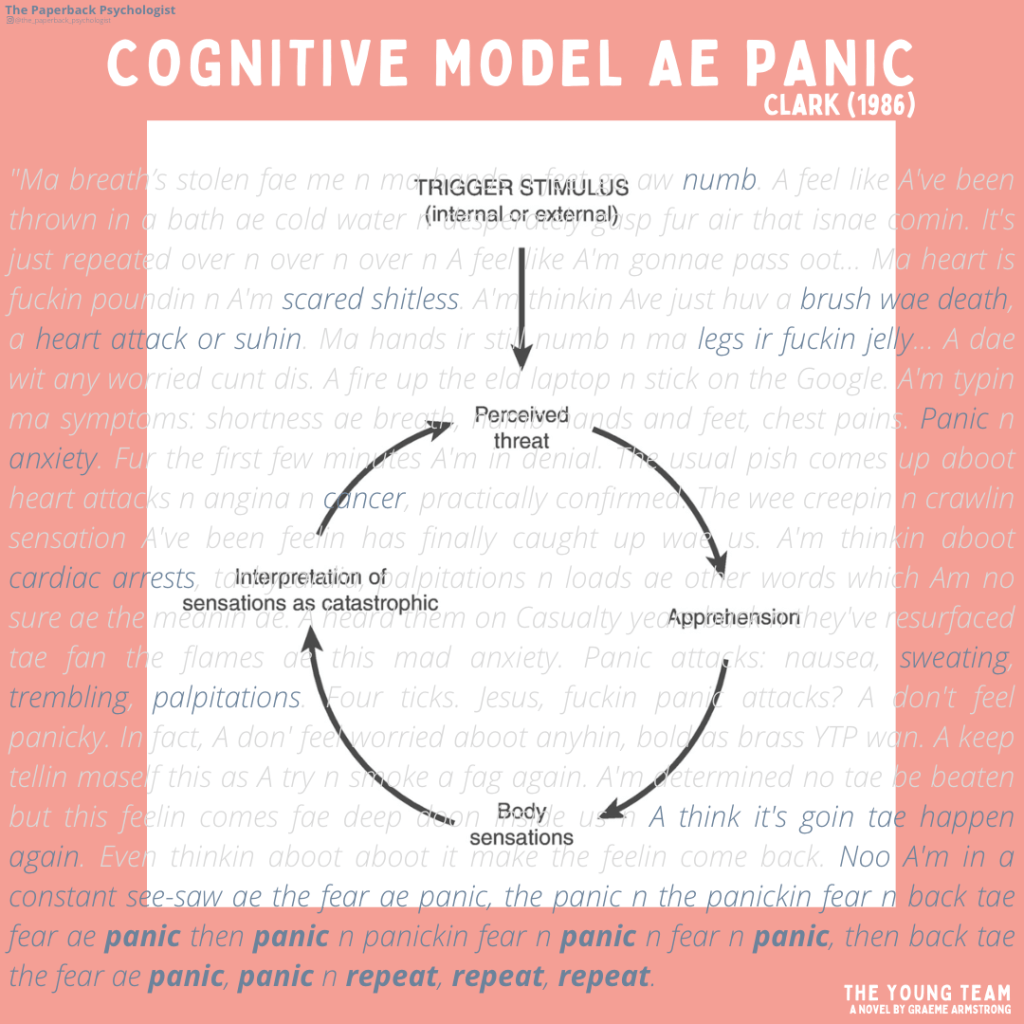
As we can see, during the course of the novel, Azzy experiences difficulties with anxiety and panic attacks. I was struck be Graeme Armstrong’s brutally accurate descriptions of anxiety, that perfectly captures the chaos that ensues between, physical/ bodily changes, emotions, thoughts and behaviour. Furthermore, he expertly captures the horrible cyclical nature of anxiety and panic that I could relate to on both a personal and professional level. The excerpt below from the Young Team is an example of how well Armstrong is able to communicate the horrible experience of anxiety and panic:
“Ma breath’s stolen fae me n ma hands n feet go aw numb. A feel like A’ve been thrown in a bath ae cold water n desperately gasp fur air that isnae comin. It’s just repeated over n over n over n A feel like A’m gonnae pass oot… Ma heart is fuckin poundin n A’m scared shitless. A’m thinkin Ave just huv a brush wae death, a heart attack or suhin. Ma hands ir still numb n ma legs ir fuckin jelly… A dae wit any worried cunt dis. A fire up the eld laptop n stick on the Google. A’m typin ma symptoms: shortness ae breath, numb hands and feet, chest pains. Panic n anxiety. Fur the first few minutes A’m in denial. The usual pish comes up aboot heart attacks n angina n cancer, practically confirmed. The wee creepin n crawlin sensation A’ve been feelin has finally caught up wae us. A’m thinkin aboot cardiac arrests, tachycardia, palpitations n loads ae other words which Am no sure ae the
meanin ae. A heard them on Casualty years back n they’ve resurfaced tae fan the flames ae this mad anxiety. Panic attacks: nausea, sweating, trembling, palpitations. Four ticks. Jesus, fuckin panic attacks? A don’t feel panicky. In fact, A don’ feel worried aboot anyhin, bold as brass YTP wan. A keep tellin maself this as A try n smoke a fag again. A’m determined no tae be beaten but this feelin comes fae deep doon inside us n A think it’s goin tae happen again. Even thinkin aboot aboot it make the feelin come back. Noo A’m in a constant see-saw ae the fear ae panic, the panic n the panickin fear n back tae fear ae panic then panic n panickin fear n panic n fear n panic, then back tae the fear ae panic, panic n repeat, repeat, repeat. A dunno wit A take drugs fur, A’m no sure why A started but A’m sure ae where it’s got me.”
The Cognitive Model of Panic (Clark, 1986) is a useful device that Clinical Psychologists use to help people understand the vicious cycle of panic. Azzy’s experience perfectly fits this model of panic as we see in the excerpt above. Clark proposes that “panic attacks result from the catastrophic misinterpretation of certain bodily sensations”.
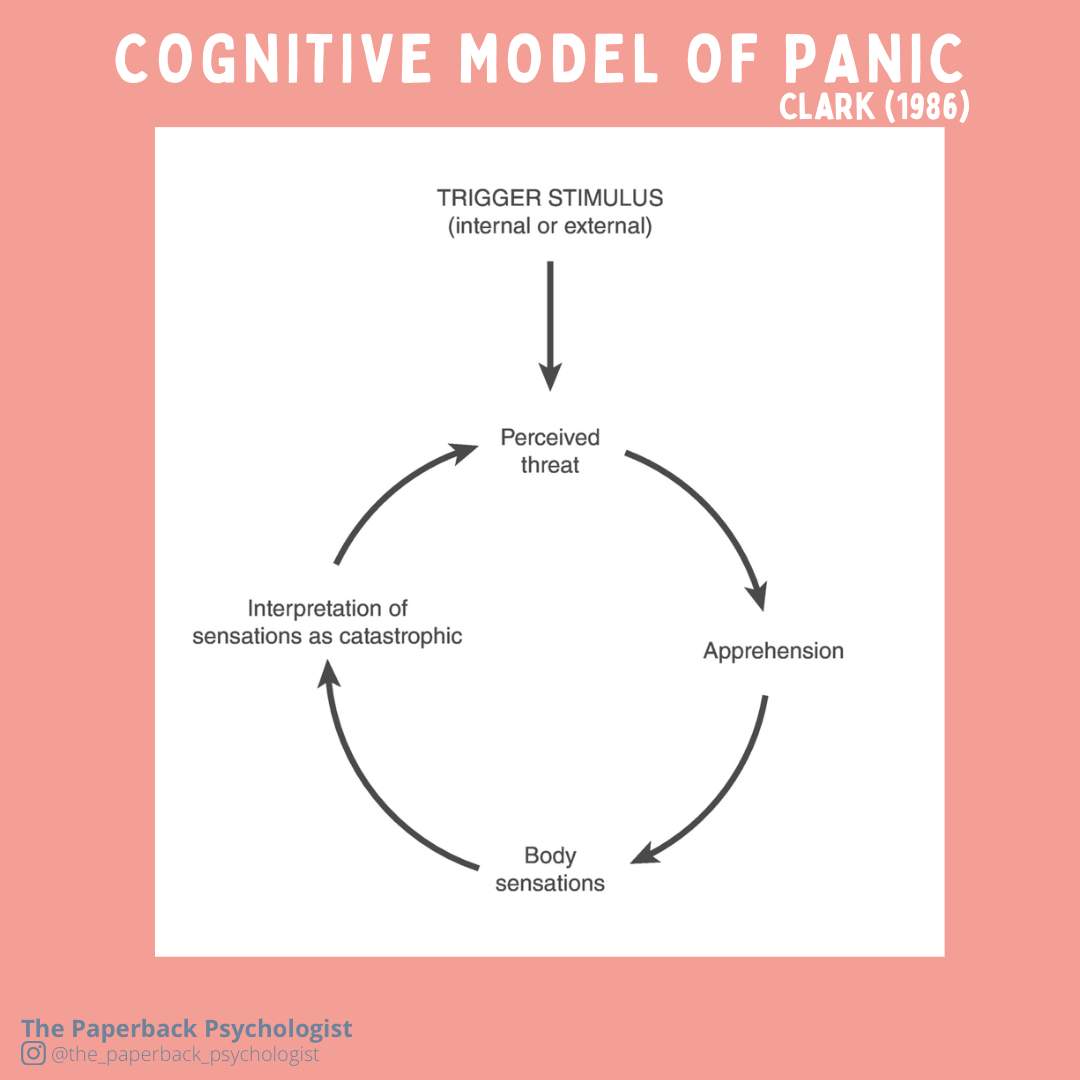
In the Young Team, the experience of panic seems to have been been provoked by changes in bodily sensations for Azzy which he interprets as being life threatening and being a sign of impending danger. This may be related to past traumatic experiences, a physical reaction to substance use, or likely both. Azzy then appears to experience a state of apprehension, which also leads to a range of bodily sensations, which are normal anxiety responses (e.g. palpitations, breathlessness and dizziness). These further physical symptoms are then interpreted as catastrophic and life threatening, which leads to a further increase in apprehension and more bodily sensations. This unfortunately develops into a vicious cycle that culminates in a panic attack: “panic n panickin fear n panic n fear n panic, then back tae the fear ae panic, panic n repeat, repeat, repeat“.
 The Paperback Psychologist
Leave a comment