Please note, this post contains spoilers
At the beginning of the year, I was gripped by Hanya Yanagihara’s century spanning To Paradise. This is my first novel of hers that I had read but I had heard a lot of great things about her writing and was aware of the excitement for her new book. In To Paradise, we meet a range of characters across time, however I would like to just focus on book III – “Zone Eight”, my favourite of the three parts, and the character of Charlie or she is affectionately known “Little Cat”.

For this formulation I have opted for a Cognitive Behavioural Therapy (CBT) based “five P’s” case formulation. This is a commonly used model to quickly develop a sense of someone’s difficulties, their past and what may be keeping these difficulties going.
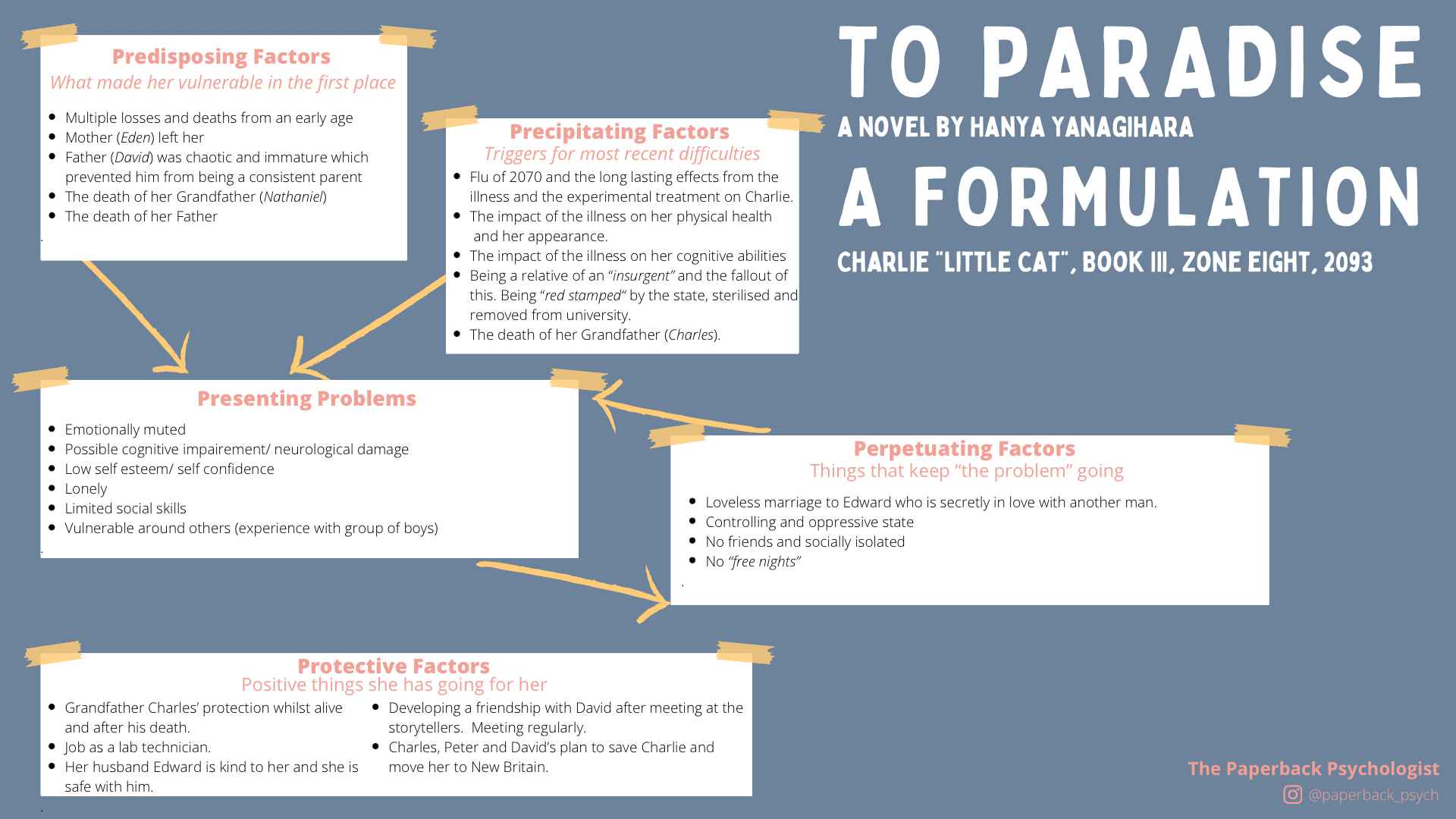
In this we are interested in how someone presents and the current difficulties that they face (presenting problems). Here we meet Charlie, taking into account her vulnerablities, her emotional bluntness and neurological/ cognitive difficulties. To better understand how we find Charlie in these difficulties, it is helpful to consider the historical events that may have shaped an individual and how they see the world. These are considered the predisposing events that may predispose us or make us sensitive to future difficulties. For Charlie, we discover that she has endured multiple losses and deaths throughout her life. Furthermore, there are specific events that can trigger current difficulties that a person faces (Precipitating factors). Charlie’s illness in the flu of 2070 and the fallout of her association with “insurgents” has played a significant role in shaping the character we meet. Alongside this are perpetuating or maintaining factors that can be the things that keep the problem going. These could also be things that someone does to cope or to control the problem. Charlie faces a number of perpetuating circumstances, mainly her loveless marriage and living in an oppressive and controlling state, with limited autonomy. Finally, it is also important to acknowledge the protective factors that an individual is likely to have. These can be related to the self, others, behaviours and circumstances which mitigate the impact of these difficulties and are positives factors in their life currently. For Charlie, she is fortunate to have had a small network of people around her and her grandfather who strive to keep her safe.
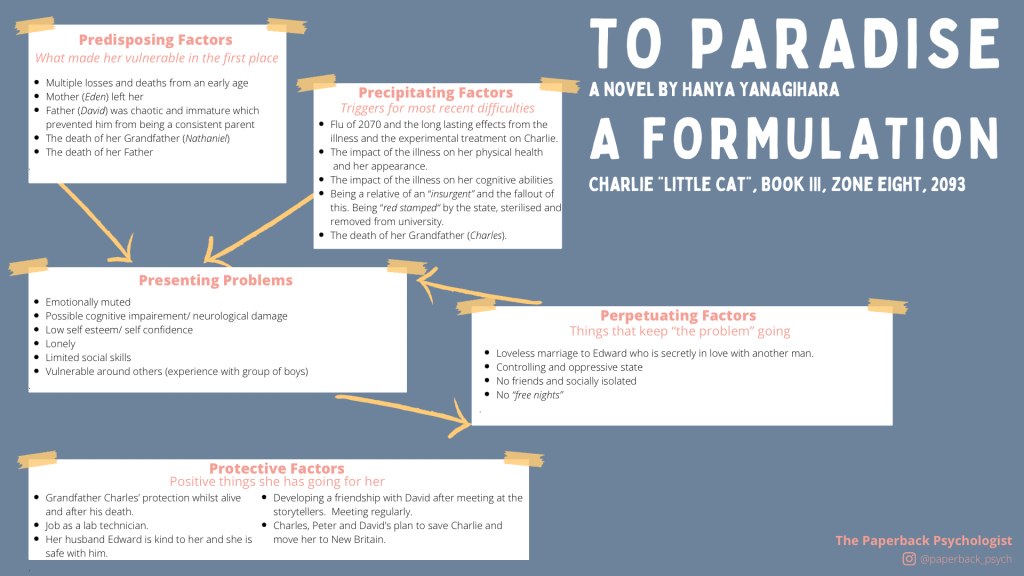
For this case study of Book III’s Charlie, I will use this formulation framework to explore all of these areas and I have presented them in the diagram above.
 The Paperback Psychologist
Leave a comment