Please note, this post contains spoilers
Like many, I have been I have been captivated by the writing of Douglas Stuart. His second book Young Mungo follows the story of Mungo Hamilton, a 15 year old boy from Glasgow, growing up in the 90’s. The book spans two time points and explores themes of sectarian gang violence, forbidden love, neglect, addiction, trauma and sexual abuse.
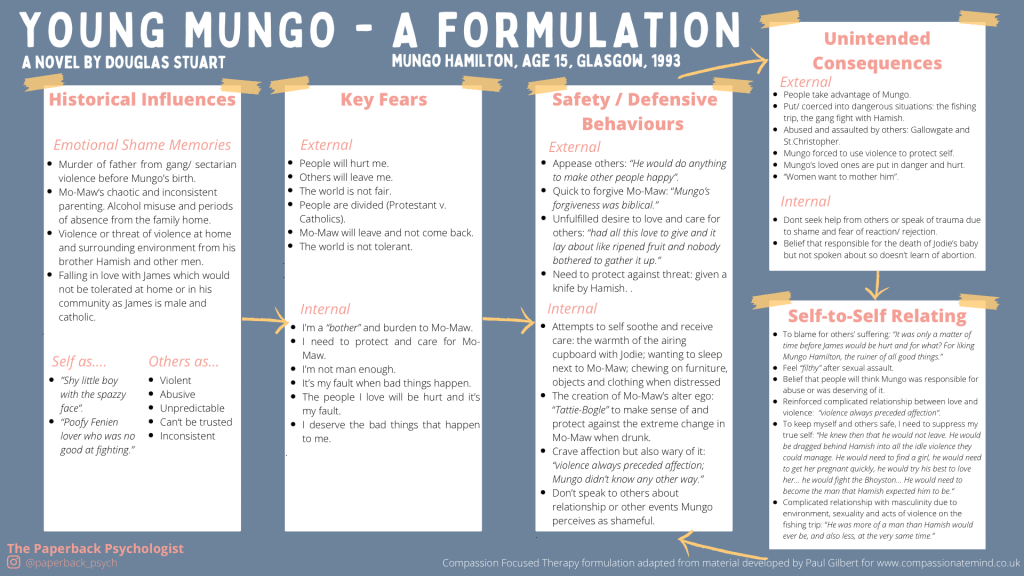
I have attempted to use a psychological case formulation based on Compassion Focused Therapy, to explore Mungo’s experiences. In the formulation below, we consider the significant historical events in Mungo’s life and how these shape how he sees himself and the world around him. These likely contribute to key fears that he has about himself and others. To protect against these fears and threats, Mungo may have developed a number of safety or defensive behaviours, which can influence how he relates to others (e.g.try to appease others and forgive Mo-Maw); or are internal strategies (e.g. attempts to self soothe in the airing cupboard or by chewing objects and furniture). Unfortunately for Mungo, despite these strategies being used to keep himself safe, they have unintended consequences (e.g. being taken advantage of and coerced into dangerous situations). This ultimately leads him into the tragic circumstances we see with his relationship with James and the abuse and violence we witness on the fishing trip. This is all likely to further confound and reinforce Mungo’s view of himself and the world around him. This in turn is likely to lead to the continued use of safety and defensive behaviours to again protect himself against this which can unfortunately develop into a vicious cycle.
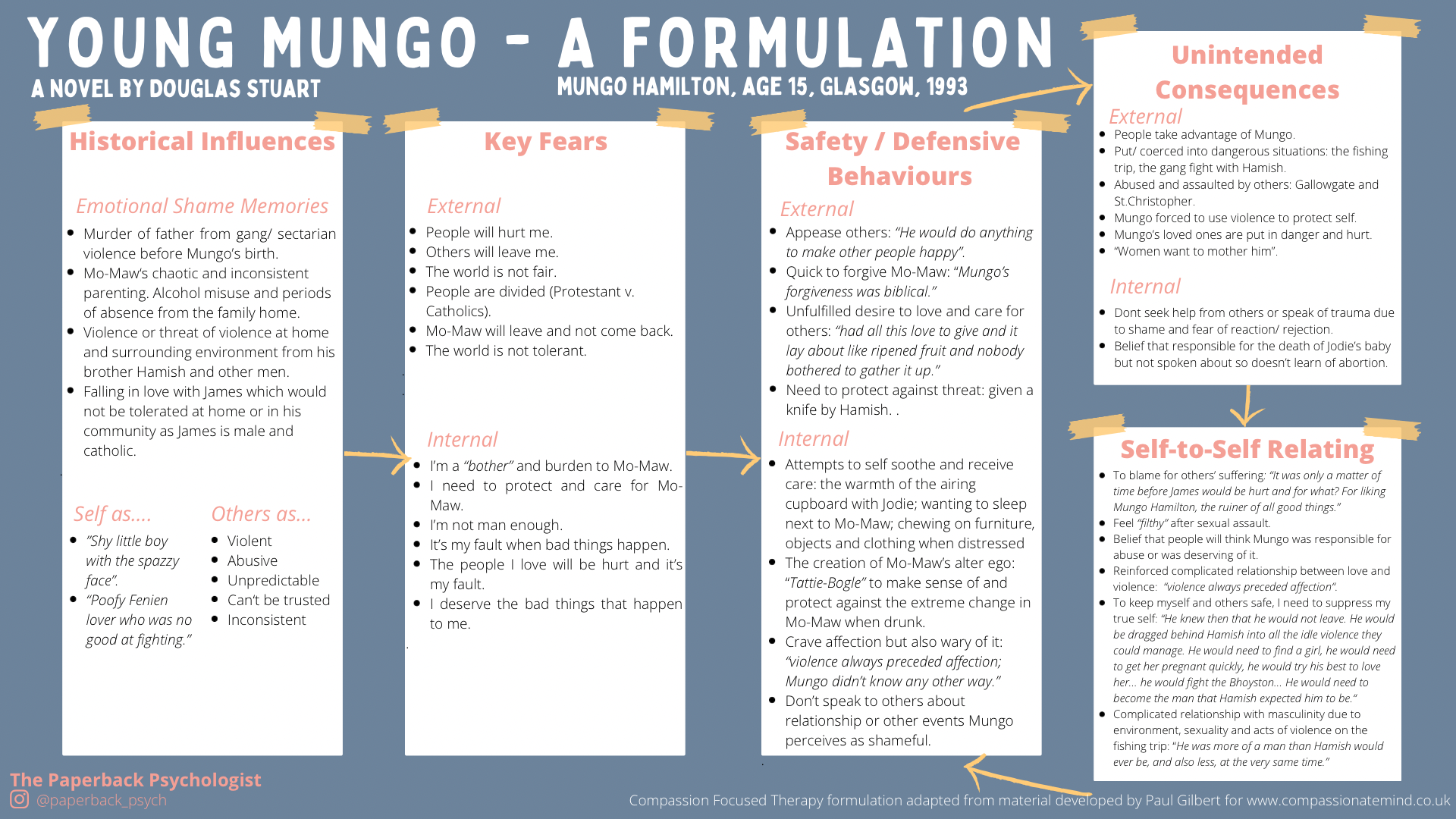
Formulation is a tool used mainly by Clinical Psychologists in therapy to collaboratively develop an explanation or hypothesis of an individual’s experiences and difficulties, which draws from psychological theory. This formulation is therefore limited as it was not created collaboratively with Mungo and is based entirely on my own inferences and interpretations from Douglas Stuart’s fantastic writing. As a result, I do not attempt to claim that this is a definitive or entirely accurate representation of the character of Mungo. I’m sure others will have different interpretations of the characters and events in the book but that’s what makes reading so magical right? I hope that anyone who has read the book finds this interesting and perhaps provides a new framework to think about the character.
 The Paperback Psychologist
Leave a comment